SimOps 101: CAE vs. Physical Testing: When to Use Which
In June 1992, a Jaguar XJ220 clocked 212 mph at the Nardo ring in Italy, making it the fastest production car in the world. Getting the aerodynamics there had taken years of wind tunnel hours: build a model, measure it, modify it, measure again. Computational tools existed, but they were a supporting input rather than the primary method.
That balance has since inverted. Every major automotive manufacturer now develops its aerodynamic package computationally first and uses the wind tunnel and the track to confirm the result. The shift did not happen because physical testing became less important. It happened because the role of physical testing changed fundamentally, from exploration to confirmation.
That distinction is the core of what this guide covers. CAE simulation and physical testing are not competing methodologies. They are different tools suited to different questions at different stages of product development. Understanding when to use each, and how to combine them effectively, is one of the most practically important skills in modern engineering.

What Each Method Actually Does
Before comparing them, it helps to be precise about what each method is for.
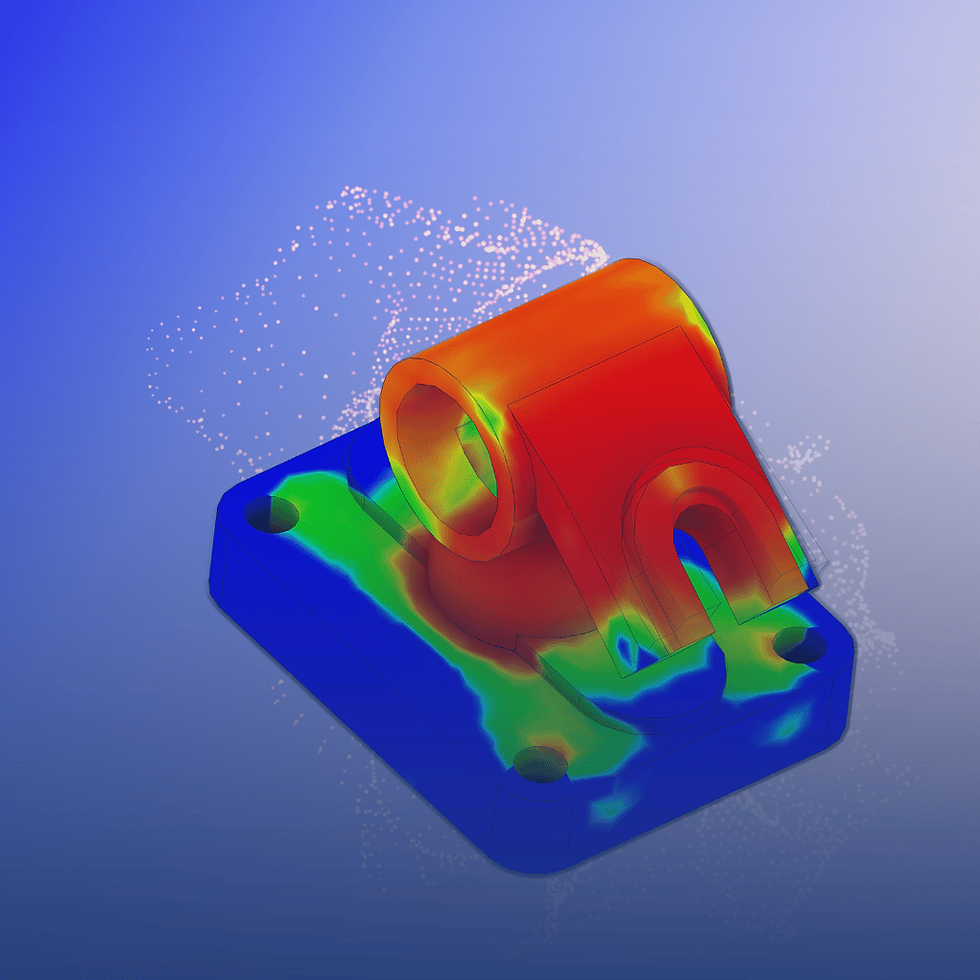
CAE simulation uses computational models to predict how a product will behave under defined conditions, before a physical prototype exists. As covered in the CAE 101 guide, simulation disciplines including FEA for structural analysis, CFD for fluid dynamics, and multibody dynamics for moving systems all share the same core logic: define the geometry, the material, the loads, and the boundary conditions, then let the solver compute the response.
The simulation's output is a prediction. It tells you what the model expects to happen. The accuracy of that prediction depends on how well the model captures real-world conditions: material behavior, boundary conditions, contact definitions, and the physics being modeled. A well-validated simulation is highly reliable. A poorly set up simulation can be confidently wrong.
Physical testing applies real loads, environments, or conditions to a real object and measures what actually happens. Strain gauges, accelerometers, load cells, pressure transducers, thermocouples, and high-speed cameras capture data that is, by definition, what the physical object did. Physical testing does not depend on modeling assumptions. It measures reality directly.
The limitation is that physical testing only tells you what happened at the measurement points you instrumented. It does not tell you the full stress distribution across a component, the pressure field around a body, or the temperature gradient through a wall. Simulation fills those gaps. Physical testing validates whether the simulation's picture of reality is accurate.
Where CAE Wins: The Strong Cases for Simulation
Early Design Exploration
Before a physical prototype exists, physical testing is impossible. Simulation is the only way to evaluate design concepts, compare alternatives, and identify failure modes during the concept and preliminary design phases.
The economics of early simulation are compelling. Catching a design flaw in the virtual model costs the engineer's time to run and revise a simulation. Catching the same flaw after tooling has been committed can cost orders of magnitude more. The trend in automotive engineering is now to conduct extensive CAE analyses first to narrow down evaluation alternatives, and then to conduct limited physical tests when prototype components are available for validation purposes [1].
High-Volume Parametric Studies
Simulation can run hundreds of design variants, load cases, or parametric combinations at a fraction of the cost of building and testing multiple physical configurations. An optimization study exploring 500 combinations of wall thickness, rib geometry, and material grade is routine in CAE. Running 500 physical test variants is not.
This is where cloud HPC becomes a direct enabler. As detailed in the SimOps post Why Cloud HPC Is the Future: Benefits and Cost Savings, cloud compute resources allow teams to run large parametric sweeps without being constrained by on-premise hardware capacity.
Full-Field Data
Physical testing gives you data at measurement points. Simulation gives you data everywhere. A crash simulation shows the stress state at every element in the mesh at every timestep. A CFD run shows the pressure and velocity distribution across the entire flow field. A thermal analysis shows the temperature at every node in the model.
This full-field visibility is particularly valuable for finding unexpected failure locations, optimizing material distribution, and understanding how design changes propagate through a structure. A vehicle prototype costs approximately $250,000 to $1 million to build, and with 50 to 70 prototypes per development program, automakers collectively spend $10 billion per year on prototypes alone. A CAE crash simulation of the same scenario costs essentially zero to run again and shows you everything [3].
Impossible Physical Scenarios
Some conditions cannot be replicated physically. A nuclear pressure vessel cannot be tested to its burst limit in a laboratory. A spacecraft heat shield cannot be subjected to re-entry temperatures in a conventional facility. A surgical implant cannot be fatigue-tested across 20 years of physiological loading before it goes to market.
Simulation makes these scenarios tractable. It is the only engineering tool available for conditions that are physically inaccessible, economically prohibitive to replicate, or intrinsically destructive.
Where Physical Testing Wins: The Strong Cases for Testing
Model Validation
Simulation accuracy depends on the fidelity of the model. Material properties in databases are population averages, not measurements of the specific batch of material being used. Boundary conditions are approximations of real assembly configurations. Contact definitions simplify complex real-world interfaces.
Physical testing validates whether the simulation's assumptions are close enough to reality to trust the results. This correlation between CAE results and experimental data is what makes future simulations credible [2]. Without it, simulation results are predictions with unknown accuracy. With it, they are engineering evidence.
Unknown Unknowns
Simulation can only capture what the engineer modeled. It cannot discover failure modes that were not anticipated in the setup. Production vehicles are subjected to a wider variety of operating conditions than any simulation can possibly cover [3]. Physical testing with real users, real environments, and real variation exposes failure modes that were simply not in the model.
This is why full physical validation programs remain standard practice even in organizations with mature simulation capabilities. A vehicle development program might use simulation to reduce the test fleet from 80 vehicles to a dozen, but it does not eliminate the test fleet entirely [3]. Physical tests uncover what simulation misses.
Regulatory Certification
Across aerospace, automotive, and medical devices, regulatory certification requires documented physical test evidence. Simulation is increasingly accepted as part of the technical evidence package, but it does not replace mandatory physical testing requirements.
In aerospace, every structural component must be tested to demonstrate compliance with limit and ultimate load requirements under airworthiness regulations. In automotive, crash safety ratings from NHTSA and Euro NCAP require physical crash tests, not simulated ones. In medical devices, physical testing remains the gold standard in medical device verification and validation. While the FDA actively encourages the use of computational modeling and simulation through its November 2023 guidance on CM&S in device submissions, it does not offer assurances of acceptance for submissions that rely entirely on simulation without physical validation [4].
Manufacturing Variability and Real-World Conditions
Physical products have variation. Material properties vary batch to batch. Dimensions vary within tolerance. Assembly produces residual stresses that simulation typically does not model. Surface finish affects fatigue life in ways that require physical test data to characterize.
Physical testing captures the integrated effect of all of this variation on the actual product. Simulation, working from nominal values and idealized geometry, typically does not. For final product sign-off, physical testing on production-representative samples is the standard because it is the only method that measures the actual product rather than a model of it [5].
The Right Question: Not "Which?" But "How Much of Each?"
The framing of "CAE vs. physical testing" as a competition misses the point. Leading engineering organizations do not choose between them. They design their development programs to use each where it has the highest leverage.
The practical pattern, consistent across automotive, aerospace, and industrial manufacturing, works like this.
Early stage: simulation-heavy. Before physical prototypes exist, CAE explores the design space, narrows alternatives, and identifies risks. Investment in simulation at this stage returns the highest ROI because changes are cheapest to make and physical testing is not yet possible.
Intermediate stage: simulation-led, physically validated. First physical prototypes are built and tested, primarily to validate simulation models and correlate results. Physical test data is used to improve model accuracy. The updated models are then used to run additional virtual variants that would be too expensive to test physically.
Late stage: targeted physical testing. With validated simulation models available, physical testing focuses on the specific scenarios that cannot be simulated adequately: regulatory certification loads, durability in customer-representative environments, manufacturing variation effects, and final product sign-off.
Rather than replacing one with the other, leading companies use both in a complementary way: starting with CAE to filter design concepts, validating with physical testing to verify simulations, and then using the correlation between both to improve the reliability of future simulations [2].
The Correlation Challenge: Making the Two Work Together
The most technically demanding aspect of the CAE-physical testing relationship is model correlation: the process of adjusting simulation models to match physical test results.
Raw correlation is often imperfect. Simulation predicts a natural frequency of 42 Hz; the physical test measures 38 Hz. Simulation predicts a peak stress of 280 MPa at a given location; the strain gauge reads 320 MPa. These discrepancies are normal. They reflect the gap between the modeled world and the physical one.
Correlation work closes that gap. Engineers adjust material models, boundary condition definitions, contact properties, and joint stiffnesses until the simulation matches physical test results across a range of conditions. A well-correlated model can then be used to explore additional load cases and design variants with confidence that its predictions are reliable.
This process requires both simulation expertise and physical testing knowledge. Engineers who understand only one side of this boundary are less effective at correlation than those who understand both. The integration of CAE and physical testing teams, sharing data, methodology, and results on a common platform, is increasingly recognized as an organizational capability that determines how well simulation investment actually pays off.
For teams building that integrated capability systematically, the SimOps Practitioner certification is designed for experienced engineers who want to develop the operational and methodological skills to run simulation and testing workflows together efficiently.
A Decision Framework
The following questions help determine the appropriate balance of CAE and physical testing for a given engineering task.
Is the design mature enough for physical testing? If major design changes are still likely, simulation investment returns more value than physical testing. Physical testing of a design that will change significantly produces data about a product that will not be built.
Is the failure mode well-understood? If the physics of the failure mode are well-characterized and the simulation model has been validated for this class of problem, CAE results can be trusted with high confidence. If the failure mode involves unknown real-world factors, manufacturing variation, or user behavior, physical testing is essential.
Is regulatory certification required? If yes, physical testing is mandatory regardless of simulation quality. Plan for it from the start.
Is the scenario physically testable? If not, simulation is the only option. If it is, the cost and time of physical testing must be weighed against the information value it provides beyond what simulation already tells you.
Has the simulation model been validated? An unvalidated simulation model produces predictions with unknown accuracy. Physical testing to establish that accuracy is an investment that pays back across all future uses of the model.
Key Takeaways
CAE simulation and physical testing serve fundamentally different purposes: simulation predicts, physical testing measures. Simulation's advantages are early availability, low marginal cost per variant, full-field data, and access to scenarios that are physically impossible to test. Physical testing's advantages are freedom from modeling assumptions, discovery of unknown failure modes, regulatory credibility, and capture of real-world variation. The most effective engineering programs use both in sequence: simulation-heavy early, physically validated at prototype stage, targeted physical testing for certification and sign-off. Model correlation, the process of adjusting simulation models to match physical test results, is where the two methods are most tightly integrated and where engineering judgment is most critical. The question is never "which method?" but "how much of each, at which stage, for which questions?"
What's Next in This Series?
This is part of SimOps' Simulation 101 series. Related reading:
SimOps 101: How Simulation Reduces Product Development Costs
Top CAE Software Compared: ANSYS, Abaqus, Nastran
References
Bhise, V.D. (2017). Automotive Product Development. CRC Press / Taylor & Francis. taylorandfrancis.com
TASVINA. (2025). CAE: Can It Really Replace Physical Testing? tasvina.com
Automotive Testing Technology International. (2016, 2018). Virtual vs Physical Testing / Ditch the Prototypes. automotivetestingtechnologyinternational.com
Stress Engineering Services. (2025). FDA Cranks up Pressure for Modeling and Simulation. stress.com
Wikipedia. (2025). Computer-Aided Engineering. en.wikipedia.org
About SimOps
Software development was transformed when teams stopped treating infrastructure as an afterthought and started building shared practices around it. That's what DevOps did for code. SimOps is doing the same thing for simulation.
Simulation and HPC have long operated in silos: different tools, different teams, different workflows, with no shared language or common standards. SimOps exists to change that. We're building a framework and a community where simulation engineers, HPC specialists, and CAE teams can work from the same playbook, share best practices, and push the field forward together.
If that mission resonates with you, this series is a starting point. And the community is where the conversation continues.